
Misconceptions on Islam (I)
Debunking stupid people with FACTS and LOGIC

Muslims are many things, positive and negative, but if you live in the West a word that would definitely not describe them is liked. Part of this is self-inflicted given a non-trivial number of Muslims living in the West act in absolutely retarded and antagonizing ways, the worst of us engaging in in Jihadist terrorist attacks. But Muslim intra-community dysfunctionality aside, the other part comes from a geopolitical realignment that started after the Cold War, when the enemy stopped being the Communist bloc and shifted toward what Samuel Huntington framed as a clash with Islamic civilization, a framing that became propaganda policy once the Global War on Terror kicked off.
The attacks of 9/11 gave the Bush administration and its neocon allies the emotional heavenly mandate to invade Afghanistan, and on that front there was near-universal support from the population. But Iraq, Iraq was a different problem. None of the 19 hijackers were Iraqi, the 9/11 Commission found no operational relationship between Saddam Hussein and Al-Qaeda, and yet Iraq became the second target with great effort on the part of the Neocons led by Dick Cheney and their eager Israeli lobbyist in whom they found extra necessary catalyzing support.1
To justify an invasion that had no connection to the attacks, the administration needed a separate casus belli going from fabricated intelligence about weapons of mass destruction, inflated claims of Saddam-Al Qaeda ties, and underneath all of it to the broader demonization of Muslims as a civilizational threat. Because at the end, that was the only real link between Iraqis and the men who flew planes into buildings: they were Muslim. Making the public fear Muslims as a category made it possible to wage war against any Muslim-majority country without having to explain the specific connection each time.2
The whole GWOT of the 2000s resulted in the destabilization of Iraq, which combined with decades of authoritarian decay, youth unemployment, and corruption across the Arab world, fed into the upheavals of the Arab Spring in the early 2010s. Some countries fractured while others collapsed into civil war. That chaos gave room to Islamist jihadi organizations, of which notably the Islamic State, which had its roots in Al-Qaeda’s Iraqi branch3 and expanded into the Syrian civil war to become the most visible terrorist entity since Al-Qaeda itself. From that breakdown came waves of migration that reached Europe by the mid-2010s, pushing the question of Islam and Muslims in European societies to the foreground. A new string of terrorist attacks on European soil in the 2010s cemented the association further.
On top of this institutional infrastructure, the nascent Internet opened up the opportunity for niches where this material found an eager audience. The people who populate these niches, what I will broadly call anti-Muslim slop producers, are not scholars, journalists, or analysts but basically content creators who found a market. Their spiritual ancestor is Robert Spencer, a Melkite Greek Catholic with a master’s in religious studies and no training in Arabic or Islamic jurisprudence, who founded Jihad Watch in 2003.
He has the merit of having understood before almost anyone else that anti-Muslim content had an online audience that would never run dry, and a stream of low IQ enemies that would constantly justify it. Spencer published “books” and ran a blog that became one of the most trafficked anti-Islam sites on the English-speaking Internet. He was actually the the one who invented taqiyya as it is understood online, taking it from an obscure Shia survival doctrine permitting denial of faith under threat of death and repackaging it as evidence that any Muslim could be lying at any time about anything.
The concept as Spencer presented it bears almost no resemblance to what the Islamic juridical tradition actually contains, but asking accuracy from slop consoomers is like asking a caterpillar to do matrix multiplication. The point here was producing a framework where no Muslim can ever be trusted via unfalsifiability, feeding into the paranoia of the times.
Spencer was not alone, David Wood, another Christian polemicist, built a YouTube channel with millions of views dedicated to adversarial readings of Islamic texts. The Israeli MEMRI4 kept producing the transformed material of cherry-picked translations of the most deranged clerics from Arabic-language media, served up without context to an audience that could not check the originals. This content did not stay in its original anti-Islam container. It bled into the New Atheist movement of the late 2000s, where figures like Sam Harris and Christopher Hitchens gave it intellectual cover by framing hostility toward Islam as rationalist critique rather than bigotry.
Harris’s infamous exchange with Ben Affleck on Bill Maher’s show in 2014 is a notorious example of this because he said it on mainstream television with the authority of a bestselling public intellectual. From there the pipeline continued: the New Atheist audience overlapped and transformed into the anti-SJW community that coalesced around GamerGate in 2014, and large parts of that community slowly drifted steadily rightward until it merged with what became the alt right at first and then dissident right. At each stage of this pipeline the anti-Muslim content was always part of the packages sometimes becoming the main product when the current monitored event needed it (2015 terrorist attacks, 2016 Köln rapes, October 7th).
Now, this explains the whole Anglo-American part, but where is Europe in the question? When it comes to Europe, they largely had the similar cultural developpments in the early 2000s given the Global part of the War on Terror meant European nations were also targets, with examples like the Madrid train bombings in 2004 (11-M) and the London bombings in 2005. That said the dynamics here are different.
In America, roughly 1% of the population is Muslims thus anti-Muslim sentiment there is mostly abstract, tied to foreign policy or to an enemy imagined as distant (those damn ayrabs). In Europe, like everything in this continent, it is not an abstract issue. For example let’s take France, who has the largest Muslim minority in Western Europe, roughly 9% of the population, most of them coming from North African families who arrived post-1960. Germany has its Turkish community of Gästarbeiters, Britain its Pakistani and Bangladeshi populations and Spain around 2 million Muslims now. In many parts these are not recent arrivals, they are second and third generation (in France some are even 4th already). The tensions here were are about real coexistence (or more like the lack thereof) in the same cities, the same schools, the same labor markets. And this was already a sensitive point well before the Islamic State existed.
After ISIS established itself, the number and regularity of attacks on European soil exploded (ba dum tss). Paris in January and November 2015, Brussels in 2016, Nice in 2016, Berlin in 2016, Manchester and Barcelona in 2017. The novelty that changes the nature of the question, is that many of these attackers were European citizens or residents and not foreigners. They had grown up in Molenbeek, Saint-Denis or Neuköln, in the same neighborhoods as the people they killed and thus the question shifted from the enemy who was over there to the one who grew up down the street.
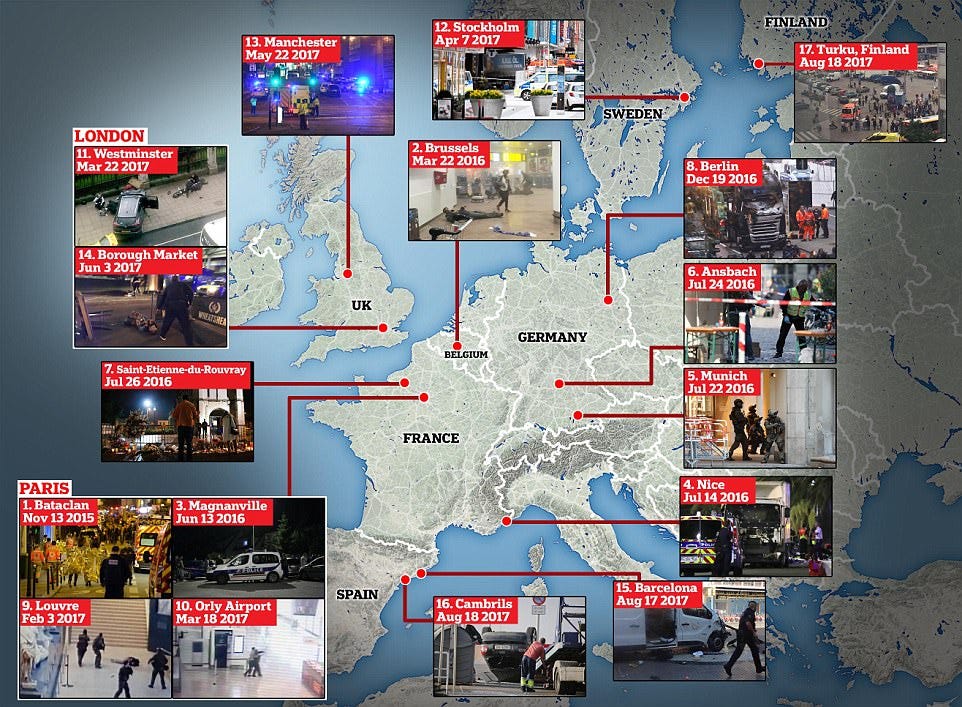
Added to this were the integration failures that predated the attacks, the 2015 migration crisis that brought over 1 Million asylum seekers into Europe in a single year, the Cologne New Year’s Eve assaults in 2015 by “Nafris”, and the economic degradation that had been grinding since 2008. All of this fed into a pressure cooker that soured large parts of European publics on their Muslim populations as a whole. And the souring ran in both directions as well. After every attack, Muslims across Europe found their loyalty questioned by default. They were expected to perform the collective innocence, to condemn, to distance, to repeat the formulaic “Islam is a religion of peace” line as a kind of loyalty oath that no one actually believed but everyone demanded. So the cycle of attack, collective suspicion, performative condemnation, resentment on both sides, repeat became the bread and butter of Jihadis.
All of this built an information environment in which misconceptions about Islam do not have a self-sustaining infrastructure. They have funding, institutional and popular backing, and a quarter-century of reinforcement. What follows is a look at the most common of those misconceptions, what the Islamic tradition actually says, and where the gap between the two has been deliberately manufactured.
Taqiyya
Of all the terms weaponized against Muslims, taqiyya is probably pound-for-pound the worst of the all. It has the highest ratio of notoriety to actual reality and it is relatively common to find muslims who don’t know about the term at all. But if you spend any time in anti-Islam spaces online, whether it is Robert Spencer’s Jihad Watch or David Wood’s videos or the comment sections of any article about Islam, you will constantly encounter the claim that Muslims are religiously permitted, nay even encouraged, to lie to non-Muslims in order to advance Islam.
The word taqiyya is usually invoked as an unfalsifiable proof. To explain why it is unfalsifiable, it means that you cannot prove or disprove the idea, because any element of evidence to disprove it can be argued to reinforce the idea itself. For example if I, a muslim, write some text trying to disprove this, an anti-Muslim apologist will just argue that I am engaging in taqiyya, lying to non-Muslims in order to advance the cause of Islam. If I as a retarded Muslim provide elements proving taqiyya, then the anti-Muslim apologist will point and say “look they are proving what we say”. As we say in France, heads I win, tails you lose.
The logic is perfectly circular as Muslims are religiously commanded to lie; therefore, when a Muslim says they are not lying, they are lying; therefore, Muslims are religiously commanded to lie. There is no possible response a Muslim can give that does not strengthen the accusation. If they explain that taqiyya is narrow and limited, they are practicing taqiyya by downplaying taqiyya. If they point to the hadith literature condemning lying, they are using taqiyya to distract from taqiyya. If they produce scholars who agree with them, the scholars are also practicing taqiyya. If a non-Muslim academic corroborates their position, that academic has been fooled by taqiyya.
It has thus become, in the anti-Islam information ecosystem, a master key that unlocks every door: any Muslim who says anything is potentially lying because their religion tells them to. Any Muslim who denies this is proving it, because denying taqiyya is itself taqiyya. Mashallah Karl Popper would be proud of such disingenuity.
Once you accept this premise that any Muslim might be lying at any time because their religion permits it, you have destroyed the possibility of good-faith engagement with any muslim and thus every interfaith dialogue is suspect. Every Muslim politician’s oath of office is theater. Every Muslim neighbor’s friendliness is a long game. Robert Spencer said the quiet part out loud in his book The Politically Incorrect Guide to Islam
Remember that the next time you see a Muslim spokesman on television professing his friendship with non-Muslim Americans and his loyalty to the United States. Of course, he may be telling the truth — but he may not be telling the whole truth or he may be just lying.
What taqiyya actually is
The word derives from the Arabic triliteral root waw-qaf-ya, meaning “caution”, “prudence” or “guarding against danger”. It is etymologically related to taqwa, a word that, in ordinary Islamic usage, means “piety” or “God-consciousness”.
The doctrinal concept was actually first formalized by Shia Muslims, and the reason is that the Shia were a persecuted minority within the Islamic world for a long time. After the Fitna wars of 656–661 AD (35–40 AH) , the Shia found themselves scattered among a much larger Sunni population that frequently killed them for their (heretical) beliefs. Taqiyya became their survival mechanism and a Shia Muslim living under a hostile Sunni caliph could outwardly present as Sunni meaning pray in the Sunni manner, attend the Sunni mosque all the while maintaining Shia beliefs internally. The doctrine was codified during the time of the sixth Imam, Jafar al-Sadiq, in the mid-eighth century AD, when the Abbasid caliph al-Mansur was actively persecuting Shia communities.
Altho here the Quranic basis though is narrow, just 2 verses. Verse 16:106 permits a Muslim to deny their faith under compulsion, provided their inner belief remains unchanged
Whoever disbelieves in Allah after their belief—not those who are forced while their hearts are firm in faith,1 but those who embrace disbelief wholeheartedly—they will be condemned by Allah and suffer a tremendous punishment.
Verse 3:28 cautions against taking disbelievers as allies:
Believers should not take disbelievers as guardians instead of the believers—and whoever does so will have nothing to hope for from Allah—unless it is a precaution against their tyranny. And Allah warns you about Himself. And to Allah is the final return.
That is the entire textual foundation.
In Sunni jurisprudence (~80% of muslims) the concept is not even called taqiyya at all. It is called idtira (necessity) or ikrah (compulsion) terms that are not specific to matters of faith but apply across the entire spectrum of Islamic law. When your life is in danger, you are permitted to do things that would otherwise be forbidden. You can eat pork, drink alcohol, pray in a Church or even deny your faith.5 And this is not a uniquely Islamic idea as every legal system in the world recognizes duress as a defense. The Christian tradition has had its own versions (and controversies) during the first centuries to reintegrate the Christians who under duress from the pagan Romans denied their faith. In here the best Sunni example is the Moriscos of 15th-century Spain, forced converts from Islam to Christianity, practiced a form of dissimulation which triggered the creation of the Inquisition. The point is that the permission to lie under threat of death is not a distinctive feature of Islam.
Shia jurisprudence, which discusses taqiyya most extensively, is also most explicit about its limits. According to the rulings compiled and the Shia legal traditions, taqiyya is forbidden in two categories of cases.
First: if a scholar’s concealment of their beliefs would allow irreparable damage to be done to Islam meaning, if someone is ordered to write a book against the Quran or to provide a false interpretation of Islamic law then taqiyya is not permitted even under threat of death.
Second: if practicing taqiyya would lead to the killing of an innocent person.
The Imam al-Baqir is quoted: “We instructed taqiyya in order to protect blood. If blood is to be spilt, taqiyya is not allowed”. Thus the doctrine that is presented by anti-Islam polemicists as a blanket license to lie contains, within its own jurisprudence, explicit prohibitions against using it to deceive, to harm, or to distort the religion itself.
There is one more point about taqiyya that the critics systematically obscure: it is not even a Sunni-non-Muslim issue. Its primary historical context is Muslim-on-Muslim persecution as it is of Shia hiding from Sunni, not Muslims hiding from Christians or Jews. The concept was developed by a persecuted minority within Islam, for use within Islam and to survive within Islam. The fact that this intra-Muslim survival mechanism was then repackaged as a tool of civilizational jihad against the West is an impressive feat of creative reinterpretation that would impress even the most cynical propagandist.
Nifaq
If the critics were genuinely interested in what Islam says about lying (even to advance Islam), they would not be talking about taqiyya but about nifaq. It is of course a big coincidence they rarely do and not at all an indictement of the quality of their scholarship or the purpose of their propaganda.
Nifaq, meaning hypocrisy or double feelings, is unlike the footnote in Islamic theology that taqiyya is, one of the most extensively treated moral and spiritual concepts in the entire Quran. The textual disparity between taqiyya and nifaq is big and worth quantifying.
Taqiyya rests on 2 Quranic verses and neither uses the word taqiyya explicitly. The concept is always inferred from contextual language about precaution under duress.
Nifaq, by contrast, saturates the Quran. The word munafiq (hypocrite) and its derivatives appear over thirty times. The Quran dedicates an entire surah to the subject Surat al-Munafiqun, 11 verses focused exclusively on the nature and fate of hypocrites. But that is only the beginning. Surah al-Baqarah (the longest) opens with thirteen consecutive verses describing the hypocrites, using two extended parables, one of fire and one of storm, to illustrate their spiritual condition. Surah an-Nisa addresses them in verses 138–145. References appear throughout the Quran in chapters covering every major theological and social theme. Classical exegetes devoted extensive commentaries to these passages. Entire books were written by hadith scholars on the subject works that constitute a genre of Islamic scholarship.
The punishment assigned to the hypocrite/liar is, in the Islamic moral universe, the worst punishment conceivable. Verse 4:145 states: “Indeed, the hypocrites will be in the lowest depths of the Fire — and never will you find for them a helper”. The Quran describes nifaq as a “disease of the heart”, and unlike ignorance or unbelief, which can be sincere errors, nifaq is defined as knowing betrayal. Let it be noted that the punishment for hipocrisy is lower than the disbeliever who openly rejects Islam and lower than the polytheist.
The Prophet Muhammad’s (ﷺ) hadith on the subject are equally unambiguous.
The signs of the hypocrite are three: when he speaks, he lies; when he promises, he breaks it; and when he is entrusted, he betrays
A fourth sign was added in another narration: “and when he argues, he is wicked.” These hadith are among the most frequently cited traditions in all of Islamic education and I think every Muslim child who attends any kind of religious instruction will eventually encounter them. They are repeated in Friday sermons across the world and basically every Muslim knows about them.
Now, a competent critic would respond to all of this with a specific objection, and it is worth stating honestly because it is the strongest version of their argument. They would say: nifaq condemns lying within the Muslim community as it protects in-group trust. Taqiyya permits lying to outsiders and therefore the two doctrines are not contradictory but complementary giving us total honesty among Muslims, permitted deception toward everyone else. Islam has an in-group/out-group morality on truth-telling, and you have just proved our point.
This sounds cleanbut it is wrong, and the hadith already cited is what kills it. "When he speaks, he lies" has no qualifier “to muslims”. The condemnation targets lying as a general character trait and a disposition of the soul, not a context-dependent behavior aimed at a particular audience. A person who lies is a munafiq regardless of who he lies to.
A good example of how nifaq and lying is seen comes to us from Islamic Education. A commonly used compilations of hadith in Sunni education, dedicates an entire chapter to the prohibition of lying Kitab al-Adab, the chapter on falsehood (260) and the prohibition is explicit. It does not carve out an exception for non-Muslim audiences because the classical scholars who built Islamic ethics treated deception as a universal moral defect and not a tactical tool with permitted targets.
But there is a deeper theological argument, taqiyya and nifaq are structural inversions of each other.
Think about it through the Islamic legal categories.
A person who believes in Islam inwardly and declares it outwardly → open faith
A person who rejects Islam inwardly and declares rejection outwardly → open disbelief
A person who rejects Islam inwardly but declares Islam outwardly → nifaq
And a person who believes in Islam inwardly but declares disbelief outwardly → taqiyya
Thus nifaq is false Islam on the outside, disbelief on the inside while Taqiyya is true Islam on the inside, false disbelief on the outside. Another annex point is the traditional limits on when not to do taqiyya in the Shiia framework (most developped one). Here Imam al-Baqir is quoted directly
We instructed taqiyya in order to protect blood. If blood is to be spilt, taqiyya is not allowed.
The doctrine that Spencer and his imitators present as a blank check for deception contains, within its own jurisprudence, a self-destruct clause: it cannot be used if it leads to someone being killed, and it cannot be used to distort Islamic teaching itself.
Yarden Mariuma6 states this distortion pipeline in a 2014 paper in The Muslim World, tracing how taqiyya which was originally a narrow juridical term whose meaning varied across sects, centuries, and political contexts then was extracted from its original framework and repackaged as a central pillar of Islamic doctrine by anti-Muslim polemicists. Mariuma showed that the same term was being used by U.S. prosecutors to explain terrorist behavior and by far-right politicians to demand that Muslim leaders publicly “revisit” the concept. The word had jumped from a footnote in Shia survival jurisprudence to a geopolitical accusation, and the people driving that jump had no training in Islamic law and no interest in acquiring any.
To conclude this part, basically lying and hipocrisy if not on the verge of death or major pressure (and no, expanding Islam doesn’t count as one) is not part of Islam, but you are always free to conclude I am doing taqiyya to you. As I discussed earlier, it is an unfalsifiable belief and thus no amount of argument can pull you off it if you don’t want it to.
Cousin Marriage
There is a widespread claim that Islam promotes or encourages cousin marriage, which in its strongest form is simply false. But the claim is useful in its popularity, and understanding why requires noticing what it actually does in the discourse. Most Westerners have an instinctive reaction to cousin marriage as a marker of backwardness meaning something primitive, that the civilized world left behind. By linking this reaction to the adherents of an entire religion, you can smuggle in a broader othering: if they still do that, imagine what else they still believe. Cousin marriage becomes a Trojan horse for a larger argument about civilizational inferiority. The problem is that the horse is hollow, and the people pointing fingers can find ancestors engaging with the practice not too long ago.
Let’s start with the Europe. Queen Victoria married her first cousin Prince Albert. Charles Darwin married his first cousin Emma Wedgwood, then spent years agonizing over whether their consanguinity caused the poor health of their children. Darwin's son George calculated that in 1873, cousin marriages comprised roughly 4.5% of aristocratic marriages and 3.5% of upper-middle-class marriages in England. A study of European nobility between the XVIth and XVIIIth centuries found that 4.1% of marriages were between first cousins and this was among the class that ran the continent.
In Spain, consanguineous marriages hit 7.4% of all marriages between 1925 and 1929, and remained elevated well into the 1940s and 1950s. Similarly France has had a consanguineous marriage rate of roughly 2% in the XIX century. Louis XIV married his first cousin on both sides Maria Theresa of Spain. The Catholic Church formally prohibited cousin marriage through much of the medieval period but issued dispensations very frequently and after the Fourth Lateran Council of 1215 reduced the restriction from seven degrees to four, the practice became even more routine among propertied families.
The European bourgeoisie used cousin marriage for similar reasons to those that make it persists in the Gulf and South Asia today: to consolidate wealth and keep property within a trusted circle. The widespread Western taboo against it is largely a product of the late XIXth century, when emerging genetic science made the health risks visible and eugenicist campaigns pushed for bans. Before that, it was simply how propertied European families operated and the taboo is roughly 150 years old. The practice is old and treating it as evidence of Islamic civilizational failure requires a very selective memory about what European civilization was doing the day before yesterday.
And then there are the specific cases that demolish the Islam-specific framing entirely. Ashkenazi Jews were historically one of the most endogamous communities in Europe. Confined to shtetls, forbidden from marrying non-Jews by both their own religious norms and state-mandated discrimination, they practiced in-group marriage for centuries. Sephardic Jews had consanguineous marriage rates reaching 20% in some communities. The genetic consequences are documented as Tay-Sachs, Gaucher disease, and other conditions elevated by centuries of endogamy. Nobody correctly attributes this to Judaism as a religion promoting cousin marriage. It is understood as the product of a persecuted minority living in closed communities where the marriage pool was small.
The same structural explanation applies to Muslim communities, but for Muslims it is treated as a religious commandment rather than a sociological pattern. South Indian Hindus are the example that should end the argument. Among Dravidian Hindu communities in Karnataka and Tamil Nadu (South India), consanguineous marriage rates reach roughly 3025% and these include not just cousin marriage but uncle-niece unions, which are more genetically extreme than anything the Islamic tradition permits.
Nobody calls Hinduism a religion that promotes incest, because the honest framing is obvious: these are regional cultural practices tied to clan structures, property systems, and local custom, not to the theology of the Bhagavad Gita. The same honest framing is available for Islam.
Now, the counterargument a serious critic will raise is that the rates ARE higher across Muslim-majority countries as a group which is true, but there remains a large variance between the different Islamic countries. Pakistan sits at roughly 63%. Saudi Arabia is between 33 and 50 % depending on the study. But the question is what explains them and Islam as a theological system does not, due to the variance amongst Islamic countries. Indonesia is the largest Muslim-majority country on earth, with over 230 million Muslims, and its consanguineous marriage rates are low. Turkey is at roughly 20% and declining. Morocco sits between 10 and 19%, the lowest in the Arab world.
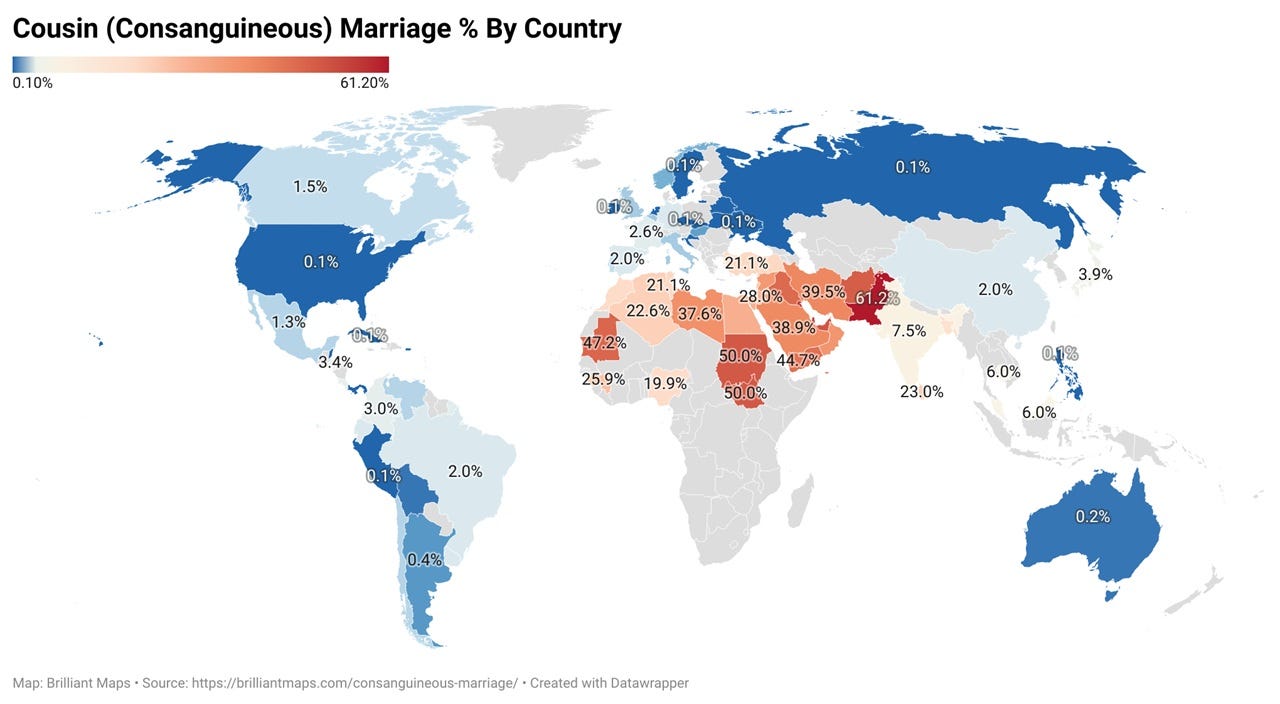
The anthropologist Andrey Korotayev made a point I liked: non-Arab groups that Islamized adopted Arab cousin marriage norms not because Islam required it, but because adopting Arab cultural practices was a way to raise social standing in an Arab-dominated civilizational order. The practice spread as Arabic culture, riding on the back of religion, and over centuries the two became confused. But this raises an obvious follow-up question: if the practice is cultural rather than religious, why has it persisted so tenaciously in some Muslim-majority societies and declined in others? The answer, I think, lies in the interaction between Islam's legal neutrality on the question and the underlying social structure of the society in question.
In clan-organized societies where kinship, tribal affiliation, and extended family networks are the primary organizing units of political and economic life, a simple neutral legal stance on cousin marriage creates no friction against the existing current.
The clan logic then becomes self-reinforcing. You have to marry inside the extended family to consolidate property, maintain alliances, cement loyalty, keep wealth from dispersing etc. If the dominant legal and moral framework says this practice is neither forbidden nor encouraged, then the clan logic operates unopposed. Over generations, the neutral permission ossifies into custom, the custom hardens into expectation, and the expectation eventually gets mistaken for religious duty.
The drift is initially slow enough that no single generation notices it happening, but over centuries the result is a society in which cousin marriage is treated as something Islam mandates when in fact Islam merely tolerated it.7 The critical variable is whether anything intervenes to break that drift. And the evidence across Muslim-majority countries points to the same answer: state capacity, urbanization and willingness to act against clan structures is the fastest and most reliable mechanism to dismantle it though not the only one as Turkey shows us.
The great Atatürk did not gently suggest modernization but forced it. He imported the Swiss civil code wholesale in 1926, abolished the caliphate8, dissolved the religious orders, imposed the Latin alphabet, and built a centralized secular state that deliberately shattered the Ottoman-era clan and religious infrastructure. The Turkish state did not ask tribal leaders (or people of the millet system) for permission to modernize family law or any law, he just imposed a new legal framework and run with it.
The result is a consanguineous marriage rate of roughly 20% which is still not European levels, but a dramatic drop from what the regional baseline would predict, and still declining. Morocco took a different path to a similar result. The 2004 Mudawwana reforms, backed by King Mohammed VI and grounded explicitly in the Maliki legal tradition, modernized family law in ways that disrupted endogamous patterns from within the Islamic framework rather than against it. The reforms did not ban cousin marriage (as it is religiously permitted) but they restructured marriage law to emphasize individual consent, women's contractual rights, and judicial oversight in ways that weakened the clan's grip on marital decisions. Morocco's rates sit between 10 and 19%, the lowest in the Arab world. French colonial influence and urbanization also played their roles, but the state-led legal framework created the conditions for the shift.
Pakistan is the opposite proof but one that reinforces our point. The biradari system (the clan-based kinship network) is an element that has large influence in Pakistani society (notably the rural one). It determines who you marry, who you vote for, who you do business with and whose disputes you intervene in.
The Pakistani state has never mounted a sustained intervention against these structures because of the classical weakness of the state in face of the civil society (similarly to India). Elected officials depend on clan networks in order to deliver votes thus breaking the biradari would mean breaking the political system that keeps them in power. The endpoint is a consanguineous marriage rate of 63 percent that has remained essentially stable for three decades. Given that no external force has managed to push against the drift, the drift continues undistrubed.
Saudi Arabia is the same proof from a different angle. The House of Saud is not a modern state that happens to govern tribal people, it is more a tribal dynasty that built its legitimacy through tribal alliances and maintains power through them. The Saudi state itself is a clan structure and thus the tribal logic and the state logic point in the same direction, so consanguineous marriage rates remain between 33 and 50 percent, and nothing internal to the system generates pressure for change.
But the pattern is consistent in the Islamic world. Where a state with modernizing ambitions has intervened against clan structures, through secular revolution as in Turkey or through legal reform grounded in Islamic jurisprudence as in Morocco, cousin marriage rates have fallen. Where the state is weak, captured by clan interests or itself organized along tribal lines, the rates remain high. Thus we can see that the variable is not Islam, but state capacity.
The Quran says the same thing in Ankara, Rabat, Islamabad, and Riyadh. The rates are different because the states are different. Another factor is that urbanization and women's education also erode endogamy, but more slowly and less reliably. Every study on the data shows urban rates consistently lower than rural ones across every country. For example in the Syrian data, urban areas showed 30 percent against 40 percent in rural areas. Education, particularly women's education, correlates with declining rates everywhere it has been measured.
But these forces take generations to produce results, and in the absence of state action they can be overwhelmed by clan pressure. A family in rural Punjab that sends a daughter to university in Lahore still expects her to marry her cousin when she returns. Education may give her the tools to resist but it does not guarantee that she will be allowed to use them.
What does Islam actually say?
The Quran lists every category of woman a Muslim man is forbidden from marrying in verse 4:23
Also forbidden to you for marriage are your mothers, your daughters, your sisters, your paternal and maternal aunts, your brother’s daughters, your sister’s daughters, your foster-mothers, your foster-sisters, your mothers-in-law, your stepdaughters under your guardianship if you have consummated marriage with their mothers—but if you have not, then you can marry them—nor the wives of your own sons, nor two sisters together at the same time—except what was done previously. Surely Allah is All-Forgiving, Most Merciful.
The only absence here are cousins and this absence has been the basis for the jurisprudential consensus that cousin marriage is mubah meaning permissible. But mubah is the most neutral classification in Islamic law meaning that it carries no spiritual reward and no spiritual penalty. It is not recommended and not praised but simply not forbidden.
The only positive points is that the Prophet Muhammad (ﷺ) did marry his cousin Zaynab bint Jahsh, and he gave his daughter Fatimah in marriage to her cousin Ali ibn Abi Talib. These elements thus help us establish that the practice is lawful in Sunnah. The Quran on the other hand contains multiple verses encouraging Muslims to expand social bonds through marriage like the verse 49:13 on the diversity of nations and tribes.
O humanity! Indeed, We created you from a male and a female, and made you into peoples and tribes so that you may ˹get to˺ know one another. Surely the most noble of you in the sight of Allah is the most righteous among you. Allah is truly All-Knowing, All-Aware.1
The other verse is 25:54 on the creation of relationships through lineage and marriage.
And He is the One Who creates human beings from a ˹humble˺ liquid,1 then establishes for them bonds of kinship and marriage. For your Lord is Most Capable.
The trajectory of the text points outward, not inward which checks out with the universalist pretensions of the religion. There seems to be a common false knowledge and widely cited statement amongst muslims amounting to
Do not marry close relatives, for the child will be born weak.
But many Hadith specialists determined this is not an authentic hadith of the Prophet (ﷺ) but a statement made by the second Caliph, Umar ibn al-Khattab, after observing a specific tribe whose offspring were physically frail. He is said to have told them to marry outside of their family.
The attribution is important as it is not as important as the Prophet’s (ﷺ) one but it is the second most important figure in early Islam, a man whose legal opinions shaped Sunni jurisprudence for 14 centuries. He looked at the results of endogamous marriage and told people to stop doing it. The retards instead chose to ignore the advice and did the opposite….
The honest summary here is that Islamic law permits cousin marriage without encouraging it, while multiple strands of the tradition, the Prophet's (ﷺ) implied advice, Umar's observation, the Quranic emphasis on expanding social bonds point toward marrying outside the family as the wiser path. The high rates in parts of the Muslim world are the product of clan-organized societies in which a neutral legal stance allowed pre-existing endogamous patterns to ossify over centuries into perceived religious duty. Where states have had the capacity and the will to intervene, whether through secular modernization or through reform grounded in Islamic law itself the rates have always fallen. Where they have not, the rates remain. Given the variance we can conclude it is not Islam mandating it.
Polygamy
Polygamy is usually the topic where the gap between what the text and experts say, what Muslims say, what Muslim (men) want it to say and what non Muslims understand is usually at its greatest. It is also the topic where the fucking dawahbro industry has done the most damage. The online version of polygamy where it is presented as a kind of theological flex or a divine right for men to collect wives like stamps bears no resemblance to what the Quran actually prescribes. The real conditions are so restrictive that many serious scholars across centuries have concluded the permission amounts to a functional prohibition.
The permission comes from a single verse 4:3, and the first thing to understand is when it was revealed and why. The verse came after the Battle of Uhud, in which seventy Muslim men were killed. The result was a large number of widows and orphans with no social safety net. The verse begins not with marriage but with orphans:
If you fear that you shall not be able to deal justly with the orphans, marry women of your choice, two, or three, or four.
The permission to marry multiple women is grammatically and contextually subordinated to the welfare of orphans. It is thus a social provision and not a sexual entitlement for men. But the verse does not stop there, despite what Muslim men wish it did. It immediately imposes two conditions. The first being
but if you fear that you shall not be able to deal justly with them, then only one.
The word “justly” here is very comprehensive and does the heavy lifting. Classical jurists understood it to encompass everything going from financial provision, time, emotional attention, housing, and treatment in every dimension of married life. A man who cannot provide separate, equivalent housing for each wife cannot take a second one. Equally a man who cannot divide his nights equally cannot take a second one. Most importantly, a man who cannot provide identical financial support cannot take a second one. They are conditions that, if taken seriously, exclude the vast majority of Muslim men on financial grounds alone.
Then comes verse 4:129, which adds a Mars sized asterisk to the whole premise
You are never able to be fair and just between women, even if it is your ardent desire.
The Quran first conditions polygamy on equal treatment, then states that equal treatment is (quasi) impossible. King Mohammed VI of Morocco, in the preamble to the 2004 Mudawwana reform, stated it plainly that since God “ruled out the possibility for men to do justice in this particular case,” the Quran “thus made polygamy quasi impossible under Sharia.”
So basically polygamy is allowed with 30 asterisks attached so that only a Sultan or Emir could realistically fulfill them, making Islamic societies de facto monogamous ones.
What the different schools actually say
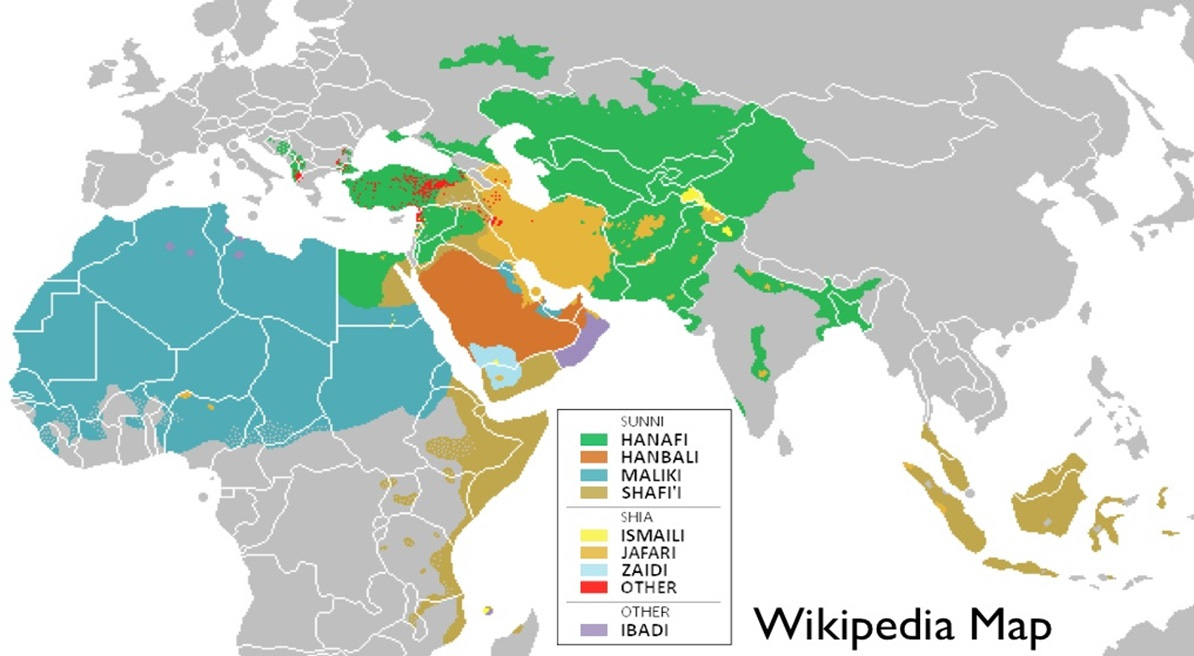
The claim that all four Sunni schools enthusiastically endorse polygamy is false. The scholarly record is far more cautious than the internet suggests.
Ibn Qudamah of the Hanbali school argue that “it is more appropriate to marry only one wife” citing the Quranic conditional we explained before as his basis. Ash-Shirbeeni of the Shafi’i school states that “it is a Sunnah not to marry more than one wife if there is no apparent need” Multiple Hanafi jurists took the position that polygamy is merely mubah (permissible), the neutral legal category which carries no spiritual reward and that monogamy is preferable as the default. Only a minority position, associated with Dawud al-Zahiri, held that polygamy is actively better than monogamy. The mainstream across all four schools is that monogamy is the norm and polygamy is an exception permitted under specific conditions of social need and not a status or social aspiration.
The Maliki school and Morocco’s implementation
The Maliki school, which predominates across North and West Africa, has historically taken a pragmatic approach to polygamy that emphasizes the protection of the existing wife. Maliki jurisprudence is the most expansive of the four schools on the grounds for judicial divorce, meaning that a wife in the Maliki tradition has more legal avenues to exit a marriage that has become harmful than under any other school. She also does not to give back the mehr (dowry) upon divorce, making it different from the other schools. This matters for polygamy because the Maliki school recognizes that the introduction of a second wife can itself constitute harm to the first.
Morocco’s Mudawwana, the national family code, nominally grounded in Maliki fiqh9 is the example of what happens when the Maliki tradition’s principles are taken seriously in legislation like for example in Morocco. After the recent 2004 reform, polygamy requires:
The husband must petition a family court judge for authorization before the second marriage can take place. Meaning that he can’t contract a 2nd marriage and inform his wife after the fact, as is common practice in much of the Muslim world.
The judge must summon the existing wife and notify her of the petition. She must appear and give her position. If she was not informed, the marriage cannot proceed.
The husband must demonstrate to the judge’s satisfaction that he has exceptional justifying circumstances. He must prove that he has the financial capacity to support both households equally including separate housing, equal maintenance, and equal provision for all children.
The court must verify that there is no risk of inequity between the wives. If the existing wife stipulated in her marriage contract that her husband may not take another wife, the petition is automatically denied.
If the wife opposes the second marriage and the judge grants it anyway, she has the right to seek divorce with full financial rights.
The practical result is that polygamous marriages in Morocco are vanishingly rare. Official records show only 658 polygamous marriages in 2020 in a country of over 37 million people. The Mudawwana did not prohibit polygamy outright as King Mohammed VI explicitly said the reform chose strict regulation over outright prohibition to prevent “illegitimate polygamy occurring if we prohibit it entirely”.
This is actually what happens usually when a Muslim-majority country takes the Quranic conditions seriously, using the Maliki school’s own jurisprudential tools. It is also, notably, the exact opposite of what the dawahbros preach.
The marriage contract as a tool
Islamic marriage law across all schools, but with particular emphasis in the Maliki and Hanbali traditions states that the marriage contract is a contract. A Muslim marriage is a contract, and like any contract in Islamic law, it can contain stipulations. The Hanbali school is the most permissive: a wife can stipulate virtually any condition, including that her husband may not take a second wife, and if he violates this condition, she has the right to seek annulment/divorce. The Maliki school considers such conditions valid but makruh (inadvisable to include but enforceable once included) meaning the condition is binding once the husband agrees to it, and breach gives the wife grounds for judicial divorce.
The fact that most Muslim women do not know they can insert a monogamy clause into their marriage contract is not a failure of Islam or Islamic law but a failure of Islamic education or rather, a success of the version of Islamic education that the traditional (male biased) culture has made dominant, which has no interest in teaching women their contractual rights.
The gap
The gap between the theory and how polygamy is actually practiced is a valley. In the Gulf states, polygamy functions as a prestige marker divorced from any social welfare context having egregious examples like an old King of Saudi Arabia having more than the 4 allowed wifes. In diaspora communities, it is sometimes practiced in secret, without the first wife’s knowledge, in flagrant violation of every school’s requirement for transparency. Among the dawahbros, the idea of multiple wives has been reduced a theological flex deployed to attract young men (incels) to a particular brand of Islam, where the permission to marry four women is the hook and the conditions that make it functionally impossible are the fine print that never gets read.
In conclusion, the verse was revealed to protect widows and orphans after a battle and conditioned on equal treatment. The Quran then also said equal treatment is quasi impossible thus the schools concluded monogamy is preferable. The Maliki tradition produced a legal framework in Morocco that reduced polygamous marriages to statistical noise. And yet, if you go online, what you will find is a 23 year-old with a ring light telling his audience that 4 wives is their God-given right.
The general conclusion to this part is that the Islamic tradition deserves better enemies, and it surely deserves better defenders. In the next iteration I will get into FGM, Slavery and the most salient topic from the comments
The question for why America did not go against Saudi Arabia (15/19 hijackers) who funded most Salafist movements in the 90s, or the Emirates (2/19) shall remain for another day. This part has also been changed because the text led to think I was meaning it was Israel’s fault. Israel was an important ally and catalyzer for the Iraq war, but not its cause. The reason they didn’t attack was oil (this is America pre-shale revolution) and nominal alliance.
After many commenters showed me that I was wrong in this, I decided to add a footnote and keep it as I wrote it for intellectual honesty. There seems to be counterevidence to this popular narrative under the form that Neocons targeted Iraq for their ideological reasons and division amongst the Israeli elite about if invading Iraq was a good idea. The devil itself first act with muslims 6 days after the attack is that he visited a mosque: https://en.wikipedia.org/wiki/Remarks_at_the_Islamic_Center_of_Washington
The neocon agenda is for those who don’t know that Iraq was a democracy in the making and that invading it would turn it into the Japan of the 21st century, a beacon of democracy in the Middle East creating a domino effect of peace, prosperity and America allies, a view most associated with Dick Cheney’s ilk.
Set-up after the invasion btw, because it is ironic that the American invasion actually put Al-Qaeda boots in Iraq.
Not many people know it but MEMRI as funny as it can be is an Israeli information company that cherry picks and translates to its benefit. If Islamists were smart they would start doing the same picking the most extreme Jews.
The limits are that you cannot do something too against Islam, no major major sins like polytheism or killing another muslim.
Annas search is your friend
This applies to many things btw.
Chad Turk giving rightful rule to Arabs, a shame they never managed to take it
Article 400 directs judges to refer to Maliki rulings and independent juristic reasoning for anything the code does not address
Your text is good, but I don’t think it touches points that are really relevant to how Muslims are viewed in the West. The main reasons people dislike Muslims in the West are:
1. The alliance between Muslims and the far left in some kind of third-worldist coalition, which put Muslins in the same side as obnoxious Greta Thurnberg-like people and creates surrealistic situations like trans for Palestine signs. The far left then hijacked the Muslims mentality driving it into a histerical victim complex, which doesn’t not help their case outside these circles.
2. The formation of ghettos and Muslim-majority areas in European city. Most Westerns feel that this is de-characterizing cities, especially the most tourist appealing ones, creating a gap between expectation and reality that is hard to grasp. This is also translated to those city-dwellers as a rapid decrease in quality of living and a real-time transformation of until then-familiar places. If Muslim immigration was actively managed Singapore-style, with Muslims being spread and not concentrating in certain areas, probably most of the animosity wouldn’t take place.
3. The very high Muslim in-group preference. This take place in different ways: from Muslims acting as a unified voting block to elect their mayors in Europe, to communities closing ranks to defend their youth from rape accusations, to every critic being labeled Islamophobia. It’s common to see Muslims saying that Imans are radical in the Wet and that if they preached like that in their home countries they would be in jail, but any attempt to do this in the West would lead the same people who said that to close ranks and scream “discrimination” and “Islamophobia”.This dynamic make it very hard from outsiders to be able to sort the wheat from the chaff and end up in whole communities being seen as their worst elements.
You are missing some aspects of why Muslims are disliked - I speak from a UK perspective a) low IQ and welfare dependency; b) clannishness and nepotism; c) disrespect of women; d) taking over public places and imposing their culture on their hosts (street praying, noisy mosques, signs in street saying no alcohol; demanding halal meat in institutions); e) cry-bullying and constant claims of Islamophobia; f) intolerance to other views, beliefs or culture; g) hatred of dogs; i) lack of respect for public places (littering, letting trash accumulate); j) arriving in a country where most of the public never wanted them in the first place; k) wanting to impose their mediaeval beliefs on others (e.g. pictures of Md. should be illegal). These are on average of course, a few are like yourself, intelligent , curious and intellectual.